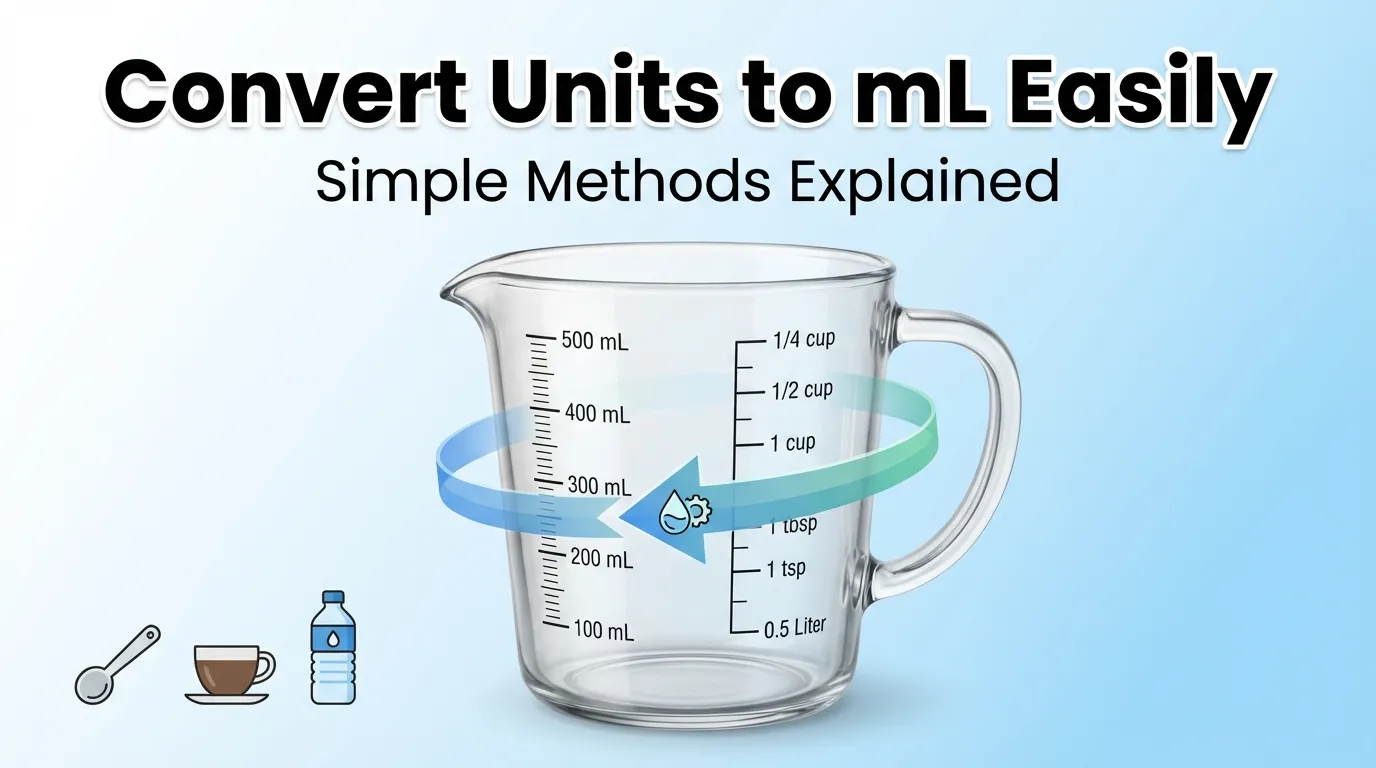
Understanding Milliliters (mL)
A milliliter (mL) is a metric unit of volume commonly used to measure liquids. It is equal to one-thousandth of a liter. Because of its small size, milliliters are ideal for measuring precise amounts of liquids such as medicine, cooking ingredients, beverages, and laboratory chemicals.
Milliliters are widely used across the world because they are part of the metric system, which is based on powers of ten. This makes calculations simple, logical, and consistent.
Why Unit Conversion to mL Is Important
Knowing How Do You Convert Units to mL is an essential life skill. It shows up more often than people realize, including:
- Cooking and baking recipes
- Measuring medicine dosages
- Science experiments
- School math problems
- Nutrition labels
- DIY and home projects
Accurate conversions help prevent mistakes, save time, and ensure safety—especially when working with chemicals or medication.
The Metric System Explained
The metric system is a standardized measurement system used worldwide. It is based on units that scale by factors of ten.
Relationship Between Liters and Milliliters
- 1 liter (L) = 1,000 milliliters (mL)
- 1 milliliter (mL) = 0.001 liters
This simple relationship makes conversions fast and reliable.
How Do You Convert Units to mL (Core Method)
The most important rule when learning How Do You Convert Units to mL is this:
Multiply the original unit by its conversion factor to get milliliters.
Let’s break this down using common examples.
Converting Liters to mL
Formula:
Liters × 1,000 = mL
Example:
2 liters × 1,000 = 2,000 mL
This is the most common and easiest conversion.
Converting Centiliters to mL
Formula:
Centiliters × 10 = mL
Example:
15 cL × 10 = 150 mL
Converting Cubic Centimeters to mL
Good news—this one is simple.
- 1 cubic centimeter (cc or cm³) = 1 mL
So no math is required at all.
Converting Household Measurements to mL
Household measurements are often used in recipes and daily tasks. These units vary by country, so accuracy matters.
Cups to mL
| Cup Type | Milliliters |
| US cup | 240 mL |
| UK cup | 250 mL |
Example:
2 US cups = 480 mL
Tablespoons to mL
- 1 tablespoon ≈ 15 mL
Example:
3 tablespoons = 45 mL
Teaspoons to mL
- 1 teaspoon ≈ 5 mL
Example:
4 teaspoons = 20 mL
Converting US vs UK Measurements
One common mistake is mixing US and UK measurement systems.
- US fluid ounce = 29.57 mL
- UK fluid ounce = 28.41 mL
This difference may seem small, but it can add up in large recipes or precise measurements.
Converting Drops and Small Volumes to mL
Drops are often used in medicine and chemistry.
- 20 drops ≈ 1 mL (standard approximation)
⚠️ Note: Drop size may vary depending on the liquid and dropper used.
Common Conversion Mistakes to Avoid
When learning How Do You Convert Units to mL, avoid these errors:
- Forgetting to multiply by the correct factor
- Mixing metric and imperial systems
- Rounding too early in calculations
- Assuming all cups or ounces are the same worldwide
Double-checking your work prevents costly mistakes.
Quick Conversion Chart
| Unit | mL Equivalent |
| 1 L | 1,000 mL |
| 1 cL | 10 mL |
| 1 cc | 1 mL |
| 1 tsp | 5 mL |
| 1 tbsp | 15 mL |
| 1 US cup | 240 mL |
| 1 UK cup | 250 mL |
| 1 US fl oz | 29.57 mL |
| 1 UK fl oz | 28.41 mL |
Tools That Help Convert Units to mL
You don’t always need to do conversions by hand. Helpful tools include:
- Online unit converters
- Smartphone calculator apps
- Measuring cups with mL markings
- Scientific calculators
- Educational websites like Khan Academy (external resource)
These tools improve speed and accuracy.
Practical Real-Life Examples
Cooking
A recipe calls for 500 mL of milk, but you only have a liter jug. You pour half—problem solved.
Medicine
A child’s medicine dosage says 7.5 mL. Using a teaspoon (5 mL) plus half a teaspoon gives the correct dose.
Science
A chemistry experiment requires 25 mL of solution. A graduated cylinder ensures precision.
Frequently Asked Questions (FAQs)
1. How Do You Convert Units to mL quickly?
Multiply the value by the unit’s conversion factor. For liters, multiply by 1,000.
2. Is 1 mL the same as 1 cc?
Yes, 1 milliliter equals 1 cubic centimeter.
3. How many mL are in a teaspoon?
One teaspoon contains approximately 5 mL.
4. Are US and UK cups the same in mL?
No. US cups are 240 mL, while UK cups are 250 mL.
5. Why is mL used instead of liters?
Milliliters allow for more precise measurement of small liquid volumes.
6. Can I convert ounces directly to mL?
Yes, but make sure you know whether they are US or UK fluid ounces.