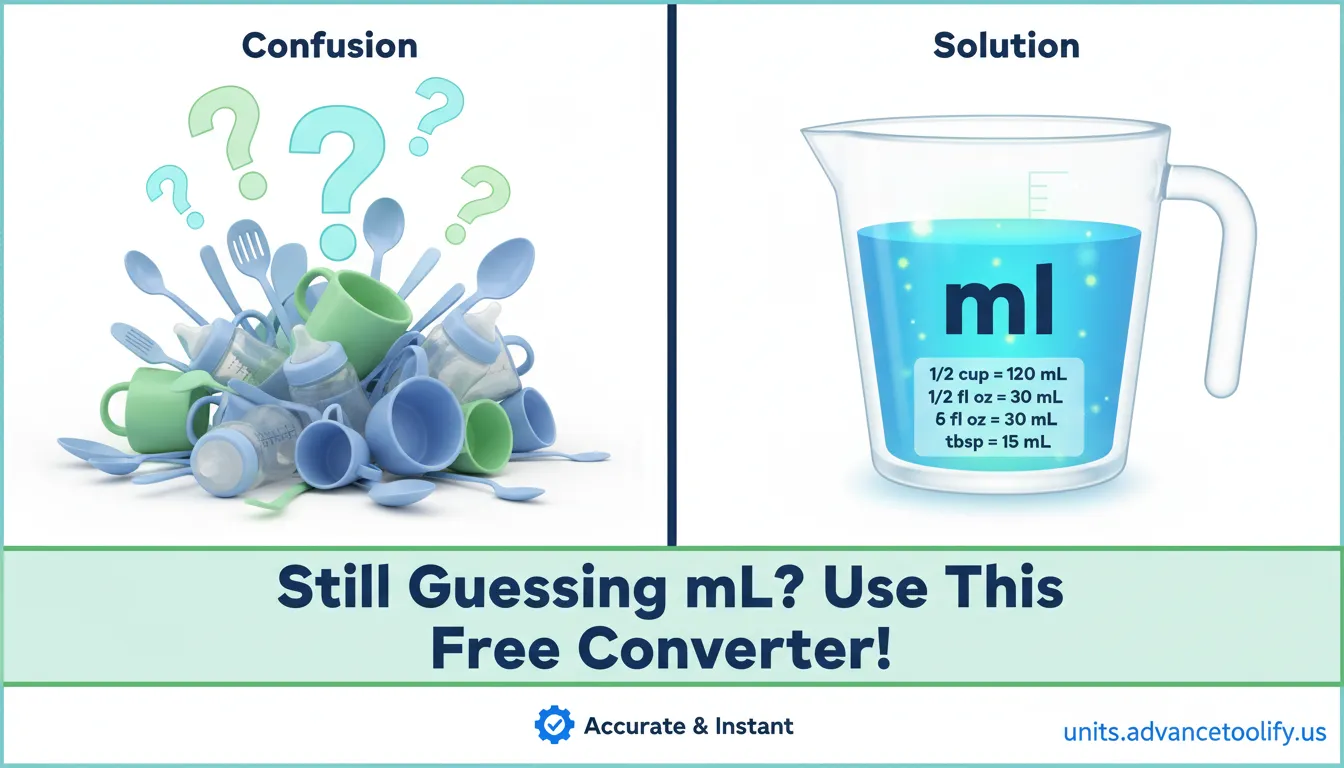
Introduction: Why Learning How to Convert Units to mL Matters
Understanding how to convert units to mL (milliliters) is an essential life skill. Whether you’re following a recipe, measuring medicine, working on a school experiment, or reading product labels, milliliters are everywhere. The good news? Converting units to mL is much easier than it sounds.
This guide explains everything step by step, using plain language, simple formulas, and helpful examples. By the end, you’ll be able to convert common units to mL quickly and confidently.
What Is a Milliliter (mL)?
A milliliter (mL) is a metric unit used to measure liquid volume.
- 1 milliliter = 1 cubic centimeter (cc)
- 1,000 milliliters = 1 liter (L)
- mL is commonly used for liquids like water, milk, oil, and medicine
Milliliters are part of the metric system, which makes conversions much simpler than imperial units.
How to Convert Units to mL: The Basic Rule
To convert any unit to mL, you multiply the value by the conversion factor for that unit.
Formula:
Amount in mL = Given value × Conversion factor
Each unit (teaspoon, cup, ounce, liter) has its own conversion factor.
Common Unit-to-mL Conversions (Quick Reference Table)
| Unit | Equals in mL |
| 1 teaspoon (tsp) | 5 mL |
| 1 tablespoon (tbsp) | 15 mL |
| 1 fluid ounce (fl oz) | 29.57 mL |
| 1 cup | 240 mL |
| 1 pint | 473 mL |
| 1 quart | 946 mL |
| 1 liter (L) | 1,000 mL |
How to Convert Teaspoons and Tablespoons to mL
These conversions are especially useful in cooking and baking.
- 1 teaspoon = 5 mL
- 1 tablespoon = 15 mL
Example
If a recipe calls for 2 tablespoons of oil:
2 × 15 = 30 mL
How to Convert Cups to mL
Cups are commonly used in recipes, especially in the U.S.
- 1 cup = 240 mL
Example
1.5 cups of milk:
1.5 × 240 = 360 mL
How to Convert Fluid Ounces to mL
Fluid ounces are often used on beverage bottles and nutrition labels.
- 1 fluid ounce ≈ 29.57 mL
Example
8 fluid ounces of juice:
8 × 29.57 = 236.56 mL
(usually rounded to 237 mL)
How to Convert Liters to mL
This is one of the easiest conversions.
- 1 liter = 1,000 mL
Example
2.5 liters of water:
2.5 × 1,000 = 2,500 mL
How to Convert Medicine Doses to mL
Medication often lists doses in mL for accuracy.
- Always use a measuring syringe or cup
- Never guess or substitute spoons
Example
If a label says 10 mL, that is exactly two teaspoons (2 × 5 mL).
Tips to Avoid Mistakes When Converting to mL
- ✅ Use standard measuring tools
- ✅ Double-check unit labels (tsp vs tbsp)
- ✅ Round only when appropriate
- ❌ Don’t confuse fluid ounces with weight ounces
- ❌ Don’t estimate medication doses
Frequently Asked Questions (FAQs)
1. Is mL the same as cc?
Yes. 1 mL = 1 cc exactly.
2. How many mL are in a tablespoon?
One tablespoon equals 15 mL.
3. How do I convert units to mL without a calculator?
Memorize key values like 5 mL (tsp), 15 mL (tbsp), and 240 mL (cup).
4. Are U.S. and metric cups the same?
Not exactly. A U.S. cup is 240 mL, while a metric cup is 250 mL.
5. Why do recipes use mL instead of cups?
mL provides more accurate and consistent measurements.
6. Can I use a regular spoon instead of a measuring spoon?
No. Regular spoons vary in size and can cause errors.